
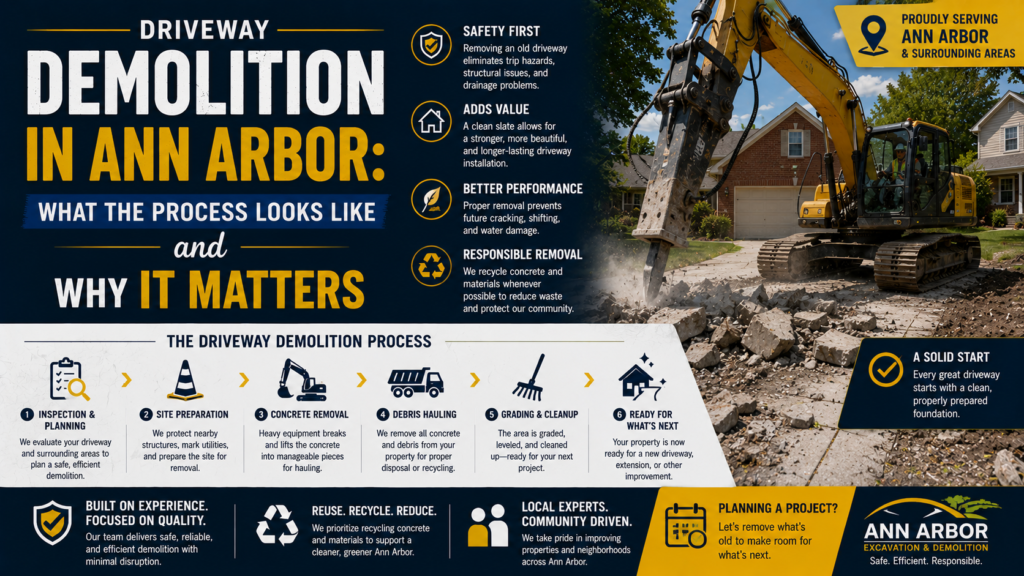
Driveways are among the most used surfaces on any property, yet they tend to receive the least attention until the damage is impossible to ignore. In Ann Arbor, Michigan, where winters are long and the combination of road salt, ground frost, and spring thaw puts concrete and asphalt under constant stress, driveways age faster than in more temperate climates. When patching and sealing no longer serve the purpose, Driveway Demolition Ann Arbor becomes the practical and necessary path forward.
Why Ann Arbor Driveways Deteriorate
Understanding why driveways fail in this region helps explain why removal is sometimes the only viable solution. Ann Arbor’s climate involves significant temperature swings throughout the year. Water infiltrates small cracks in concrete or asphalt, freezes and expands in winter, and widens those cracks with each cycle. Over several years, what began as minor surface cracking becomes full-depth structural failure.
The clay soils common to Washtenaw County also contribute to the problem. As clay expands with moisture absorption and contracts when dry, it creates uneven support beneath driveway surfaces. Over time, this differential movement causes sections of the driveway to lift, sink, or tilt. Once the substrate movement is significant, no surface treatment will restore structural integrity, and full removal becomes the appropriate next step.
What Driveway Demolition Involves
Driveway demolition is a specialized form of concrete or asphalt removal that requires the right equipment, systematic execution, and responsible disposal practices. Each stage of the process contributes to the quality of the finished result.
Assessment and Planning
Before demolition begins, contractors assess the driveway material, thickness, reinforcement, and underlying conditions. A standard residential concrete driveway in Ann Arbor is typically four to six inches thick. Some older driveways include embedded rebar or wire mesh reinforcement, which affects the removal method. Asphalt driveways tend to be thinner but can be bonded to a base layer that requires separate treatment.
Utilities are another important consideration. Before breaking any ground, underground utility lines including water, sewer, gas, and electrical must be located and marked to avoid damage during excavation.
Breaking and Removal
The actual demolition uses several types of equipment depending on the scale of the project and the proximity to structures. Jackhammers and handheld hydraulic breakers are used for precision work near the garage, curb, or landscaping features. Larger sections of open driveway may be broken using a skid steer with a hydraulic breaker attachment or an excavator. Industrial-grade machinery breaks the material into manageable pieces that can be loaded and hauled from the site.
Debris Hauling and Responsible Disposal
One of the most important services a professional demolition contractor provides is the complete removal and responsible disposal of all demolition debris. Broken concrete and asphalt do not simply disappear when the breaking work is done. They must be loaded, transported, and either recycled or properly disposed of. Concrete is commonly recycled as aggregate base material for roads and new construction, diverting substantial volume from landfills. In Ann Arbor, where environmental responsibility is a community priority, responsible demolition waste management aligns with local values.
Grading and Site Readiness
After removal, the exposed earth is graded and prepared for whatever follows. If the goal is a new concrete or asphalt driveway, proper subbase preparation is essential. This typically involves compacting the existing soil, adding a gravel base layer, and ensuring correct drainage slope so water drains away from the garage and foundation. Skipping this preparation phase leads to premature failure of the new driveway, so it is just as critical as the demolition itself.
Common Signs a Driveway Needs Full Demolition
Property owners sometimes wonder whether patching can extend the life of a damaged driveway. While minor surface cracks can be filled and sealed, certain conditions indicate that removal is the appropriate solution:
- Large-scale cracking or alligator cracking patterns across the full width or length of the driveway.
- Heaving or sinking sections where frost heave or soil movement has caused uneven elevation changes that create trip hazards or drainage problems.
- Crumbling edges and surface spalling where the concrete or asphalt has broken down to the point where the material itself is disintegrating.
- Water pooling at low points that cannot be resolved by surface treatment because the grade has been compromised.
Concrete vs. Asphalt Driveway Demolition
The demolition process differs somewhat depending on the driveway material. Concrete driveways, which are common in Ann Arbor’s established neighborhoods, are typically thicker and harder to break. Reinforced concrete requires additional effort to separate the concrete from embedded steel. Asphalt demolition is often faster because asphalt is more flexible and less brittle than concrete, but it requires careful handling to avoid contaminating surrounding soil with petroleum-based material.
What Precision Looks Like in Residential Demolition
Driveway demolition in a residential setting in Ann Arbor requires a level of care that commercial projects sometimes do not. Neighboring homes, mature trees with surface roots, underground landscaping irrigation systems, and decorative curbing or garden borders all need to be considered. Experienced contractors working in neighborhoods like Burns Park, Old West Side, or Eberwhite approach each job with care, using equipment that is appropriate in scale and operating within the footprint of the work area without damaging the surrounding property.
The Path Forward After Demolition
Driveway demolition opens the door to a fresh installation designed for the current needs of the property. New concrete driveways in Ann Arbor are typically specified with air-entrained concrete mixes that are formulated to withstand the freeze-thaw cycle. Asphalt driveways offer flexibility and can be installed faster, making them a popular choice for homeowners who want to minimize disruption. In both cases, a properly executed demolition and site preparation phase is the foundation for a driveway that performs reliably for decades.